
The next step for CRE isn’t using more AI. It’s putting AI inside the work brokers and lenders already do.
The tl;dr
AI adoption in commercial real estate is no longer the issue. 71.5% of CRE professionals expect their firms to increase AI spending, and another study cited in recent Ollo/CRE Daily research found that 88% of real estate firms are already piloting AI. Yet only 5% say they have achieved all of their AI goals.
The gap is simple: a lot of CRE professionals use AI, but much less of it is built into recurring workflows. For brokers, that means the useful question is no longer “Should I use AI?” It is:
Which repetitive parts of origination can AI actually take off my plate?
For lenders, the same applies to sourcing and prioritizing opportunities.
The goal should not be to replace judgment or relationships. It should be to spend less time searching, filtering, organizing and repeating work, and more time talking to borrowers, structuring deals and closing.
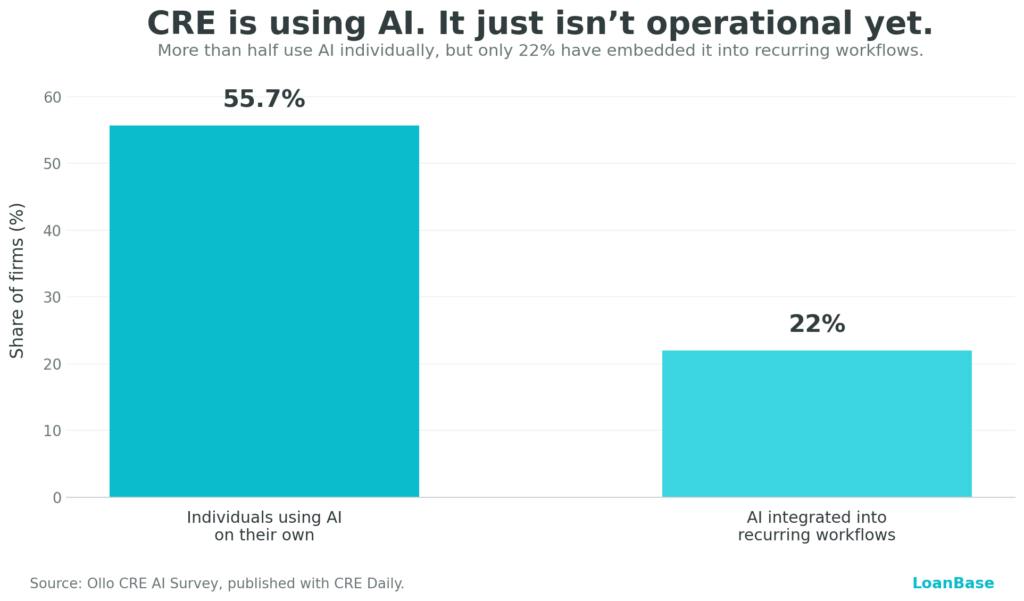
55.7% Use AI Individually. Only 22% Have Put It Into Recurring Workflows.
That may be the most important finding in the recent Ollo research published with CRE Daily.
More than half of respondents said individuals inside their firms use AI on their own. Only 22% said AI is integrated into multiple recurring workflows.
That difference matters: opening ChatGPT to summarize a document is useful. Using AI to research a market is useful. Asking it to rewrite an email is useful.
But none of those examples necessarily change how a CRE firm operates.
For a commercial mortgage broker, the bigger opportunity is to apply AI to work that happens every week:
- finding financing opportunities
- deciding which opportunities deserve attention
- researching borrowers and properties
- keeping prospecting moving
- following up
- finding relevant lenders once a deal becomes active
- comparing lender responses
That is where AI starts becoming part of the origination process rather than another tool sitting next to it.
5% Fully Trust AI for Important Decisions. That May Be the Right Number for Now.
Only 5% of respondents said they fully trust AI for important decisions. Another 17% use it with heavy verification.
That does not mean AI has failed – it means CRE firms should be careful about what they ask AI to do.
A broker should probably not hand an important financing decision to an AI model and walk away. A lender should not let AI make a credit decision simply because it can process a lot of information quickly.
But there is a large amount of work before those decisions where AI can help.
Think about the difference:
Bad use of AI:
“Tell me whether I should finance this deal.”
Better use of AI:
“Help me find opportunities that match the market I originate in, bring the relevant ones to my attention, organize the information and save me from repeating the same search every week.”
The broker still makes the decision. The lender still evaluates the deal. AI does more of the repetitive work surrounding that judgment – that distinction is important.
What Should AI Actually Do for a CRE Broker?
Start with the work you repeat:
If an originator spends hours searching databases, adjusting filters, checking maturity dates, researching owners and rebuilding prospect lists, that is a good place for automation.
The same applies if a team has strong data but still depends on each originator remembering what to search for every morning.
The goal is not “use AI.” The goal is: Give every originator more time to have qualified conversations and work active deals.
That is also the direction we have been taking with LoanBase: we already connect the core origination workflow:
Find the opportunity → Work the pipeline → Place the deal.
AI should make that workflow require less manual work, not add another dashboard that brokers need to manage.
1.5M+ Opportunities Are Useful Only If You Know Which Ones Matter to You
More data does not automatically create more pipeline:
LoanBase now covers 1.5M+ CRE financing opportunities across areas including maturing loans, early refinance situations, distressed assets, construction deals and borrower portfolios.
Without prioritization, though, a large database can simply create a larger search problem.
That is the idea behind For You: Instead of starting from zero each time you prospect, you tell LoanBase the type of opportunities you care about. The system can then use that context to surface relevant opportunities from the broader prospect universe.
The practical difference is small but important:
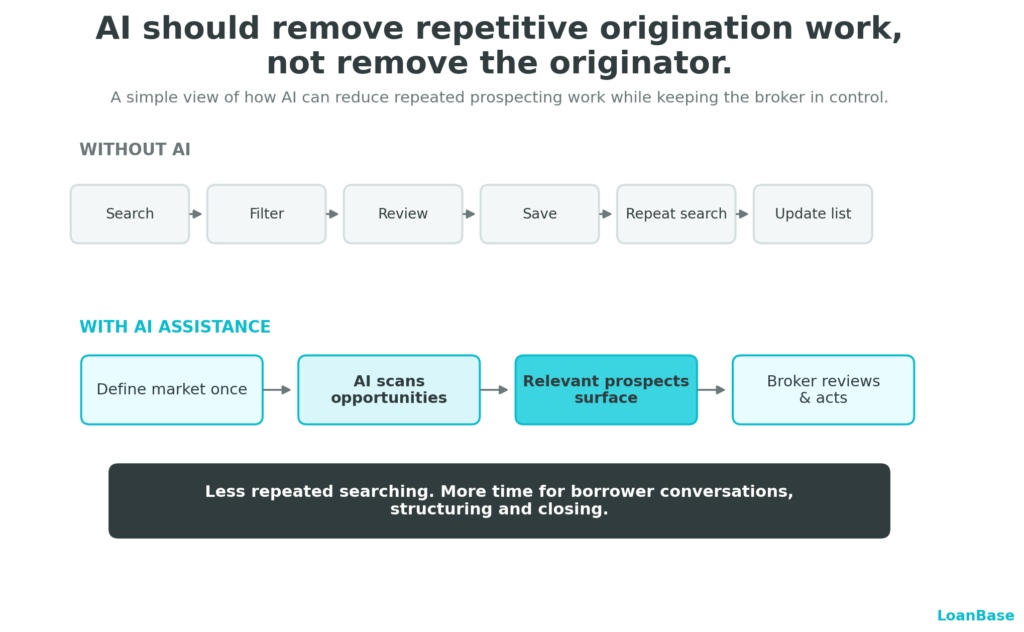
Traditional workflow:
Open database → set filters → search → review results → repeat later.
AI-assisted workflow:
Define what you are looking for → let the system keep looking → review the opportunities it surfaces.
You still decide who deserves outreach, you still build the relationship – but you spend less time repeatedly searching for the same type of opportunity.
What Should CRE Brokers Do Next?
Do not start by asking which AI tool your brokerage should buy – start by asking your originators: What do we do over and over again that does not require our best judgment?
Usually, the answers will include some combination of research, prospect discovery, data entry, follow-up, qualification and preparation. Then separate the work into three groups:
Keep human: relationships, structuring, negotiation, judgment and closing.
AI-assisted: research, prioritization, analysis and recommendations.
Automate where possible: repeated searches, routine follow-up, data movement and recurring administrative work.
For most brokerages, this is a much more practical AI strategy than trying to “become an AI company.”
What Does This Mean for CRE Lenders?
The same problem exists on the other side of the transaction.
Lenders do not necessarily need more information – they need the right financing opportunities earlier, filtered against what they actually want to fund.
If a lender’s team is manually checking lists, waiting for broker submissions or reviewing large volumes of irrelevant deals, AI can help with sourcing and prioritization before a credit decision ever needs to be made.
That could mean:
- identifying opportunities that match a lender’s geography or property types
- surfacing borrowers approaching a financing event
- prioritizing opportunities based on lending criteria
- reducing irrelevant deal flow before an originator reviews it
Again, the decision remains with the lender. The value is getting the right opportunity in front of the right person sooner.
88% Piloting AI Isn’t the Important Number
The bigger question is what happens after the pilot.
Recent research paints a consistent picture: CRE firms are investing in AI, but relatively few have turned it into repeatable operating workflows.
That is likely where the next phase of adoption happens: not more prompts, not another AI tab, not replacing brokers, lenders or underwriters – AI that quietly handles more of the repetitive work required to originate a loan.
For brokers, that can mean finding the next opportunity sooner and spending more time on conversations and deals.
For lenders, it can mean identifying relevant financing opportunities before they become broadly shopped.
And for both, the test should be straightforward: Does this AI create more time for the work only you can do?
If the answer is yes, it is probably worth paying attention to.
A Few Practical Questions About AI in CRE
How are CRE firms using AI today?
Most adoption is still relatively light. In Ollo’s survey, 55.7% reported individuals using AI on their own, while 22% had integrated AI into multiple recurring workflows.
Will AI replace commercial mortgage brokers?
That is not how we see the near-term opportunity. Relationship building, deal structuring, negotiation and judgment remain highly human activities. AI is better suited to removing repetitive work around those activities.
Where can AI help a CRE broker today?
Good starting points include prospect discovery, borrower research, opportunity prioritization, routine follow-up, data organization and lender discovery.
How is LoanBase using AI for CRE origination?
One example is For You, which helps users define the types of prospects they care about and surfaces relevant opportunities rather than requiring the same searches to be rebuilt repeatedly.
The broader direction is straightforward: use technology to reduce the repetitive work between finding an opportunity, working the pipeline and placing the deal.
Should CRE firms trust AI to make financing decisions?
AI can help organize information and support analysis, but important financing decisions still require human judgment, verification and accountability. The Ollo research reflects that caution: only 5% of respondents said they fully trust AI for important decisions.

